Category Archives: Education

Concord Grapes, Redux

Most people don’t read comments so here’s my original comment to aforementioned post:

“Concord grapes are mainly used in juices and grape jelly, also my home town was host to a winery which makes kosher wine from Concords.

Chautauqua is the home of the WCTU (Women’s Christian Temperance Union). When alcohol was banned from the US Chautauqua County, with the most grapes per acre anywhere in the US, was forced to replace its vinifera grapes with table grapes.

Years later when wine enthusiasts wanted to take advantage of Chautauqua’s unique and very brief growing season they grafted vinifera grapes onto Concord rootstock. The upshot is that NY didn’t get the phylloxera virus prevalent in Napa simply because the ancient Concord rootstock is too hardy.

Just a little tidbit of extra knowledge… D”

I also see that the bunch of grapes I photographed are kind of grainy. I did get one of the valiant rootstock, however, to share. Whenever you eat a bunch of Concords or drink Welch’s juice think of it.

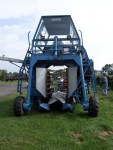
I also included a photo of the grape harvester Jim Deakin uses for his vineyards. When I was a girl, local school kids, the farmer’s kids, got out of school for a week to harvest grapes by hand. My sister and I thought it would be cool to get out of school for a week but our parents knew we were not prepared for that kind of backbreaking work, especially as we were age 8 and 6. All for now, must get dinner out of the oven and give you the recipe later. Dee

How to Eat a Concord Grape

You are used to table grapes, seedless, of course, with edible thin skins.

Concord grapes are another animal altogether. Last year we went on a vacation to see relatives in upstate NY and Canada. My father-in-law Joe is a farmer/rancher, who now raises beef cattle and who ran a dairy for many years. So my Aunt Lorna arranged for him to visit a local grape farmer and see his huge mechanical harvester.

Concord Grapes

Concord Grapes

Proprietor of Butternut Hollow/Deakin Farms is none other than Jim Deakin, a good friend of my Aunt’s and my two other favorite English teachers on this planet, Joan and Margaret. He played host to us and our guests and showed us all the equipment that helps him and his crew grow and pick grapes. We thank him for his kindness and hospitality.

The boys 1/4 mile away (next door, where we lived) taught me at the age of eight the proper way to eat a Concord grape. Take the grape and squeeze the insides between your lips, discarding the thick skin. Suck the pulp in through clenched teeth. Two or three seeds will remain outside and should be properly spat upon the ground of the vineyard you are legally picking from. Swallow the pristine pulp.

We lived next to a vineyard for three years from my age 8-10 and were told we could eat all the grapes we wanted but if the Conti brothers, the owners, ever caught us having grape fights we’d be forbidden access. Every day en route to and from the school bus hut in September and October I’d eat at least eight bunches per day! Even now, as I can’t pick them fresh in Texas, I sometimes buy a bottle of Welch’s white grape juice just to remember the taste.

Perhaps I’ll find you an Italian recipe I had in cooking school south of Florence, Italy. It was grape-picking season and at harvest time they make schiacciata a’l uvo, sort of a sweet grape pizza with wine grapes in their skins and their seeds, strewn with sugar. It’s tasty but you can only order it in restaurants in the fall.

Margie’s Pears

Jim’s mother has the largest pear tree I’ve ever seen, so tall that I don’t know how she and Joe pick the ones up top without bringing in a small crane!

Every year they pick the tree clean and Margie goes into canning mode. In the six years I’ve known her I’ve never been without a jar or ten of her preserves. I’ve not been able to join in one of these marathon sessions but should make the time to do so. I’ve always been a bit freaked out by canning. And since I can’t grow anything here besides windowsill herbs, I’d have to go out and BUY a boatload of whatever I wanted to can, thus going against nature’s bounty and immutable laws.

Generally there are two varieties of preserves: pear butter (Jim is working his way through a quart jar of that); and chunky pears with lots of cinnamon. The chunks are great on top of vanilla ice cream or mixed into yogurt.

We thank Margie for being a frugal country wife, mother and grandmother. She just bought seven goats to mow the pasture. A couple of weeks ago I came back from a visit with pickling cucumbers and baby onions. I hear that next to the term “frugal” in the dictionary is her photo. She actually figured out (she’s from a line of math geniuses that may actually include Alexander Graham Bell, and her son and my husband does calculus in his head but doesn’t have a clue about his shirt size) that every six years the days remain the same so she could re-use paper wall calendars! All she had to do was move Easter and Thanksgiving. We should start buying her pretty calendars every Fall so she’s not tempted to go back to the old John Deere.

A few months ago a fellow nurse friend of Margie’s asked her and Joe to help themselves to all the pecans that had fallen to the ground from their tree. It took Joe 45 minutes to use the special shell-cracking mechanism for pecans, and Margie the same amount of time (they work together like a well-oiled machine) to shell and pick them. The result was a stuffed quart bag of pristine, fresh pecans that are ours and I take them out of the freezer bit by bit, toast them in the oven and use in chicken salad or on top of an ice cream sundae. You should have seen my quart bag. What a mess, but then I’d never picked pecans before. It’s always good to learn new things from the experts.

Grills

I’m changing the tone here, dear readers. Let’s talk about grills. Sure I’d love one of those huge Ducane built-ins right off the kitchen on the patio, with built-in frig and wine frig. But I live in an urban environment where it’s illegal to grill anything on site, except down in the fireplace area where there are two grills for use by us “lofties.”

Let’s see, main criteria are: ease of use; portability; and easy to clean.

For years I had a full-sized (in terms of grilling space, not height) Smoky Joe that I loved. Still can’t believe I gave it away five years ago when we moved to Texas. The handle held the top on and it was easy to toss in the back of the Jeep with hardwood charcoal, chimney and newspaper, food, tools and go to the beach for a cookout. Even better, if I placed the top on and closed the vents, it was cold 20 minutes after cooking and ready to transport home. The only downside to this incredibly affordable Weber is that the grate position cannot be changed and you really need to open all the vents and use the cover to finish cooking food like steaks or chicken, making it more like an oven. This was the grill we used to feed 20-30 people at our local park every July 4th and it brings back wonderful memories.

A couple of years ago we bought a Coleman Road Trip grill for about $100. It uses small propane tanks and folds up like traveling luggage with wheels so it can be toted anywhere. The cooking plates are easy to clean especially if you have a deep or wide sink so they can be soaked before scrubbing. The plates are mostly solid, however, so sometimes food tends to steam rather than grill. It works well for our lifestyle, however.

When living in California, we had a large deck so splurged and got a Uniflame gas grill with four burners and a side burner. It had cast iron grill plates and we used it nearly every night. One winter evening we burned a whole canister of propane using it as a heater to keep us and our dinner guests warm! But with living in 1,000 sf in the big city, we chose to give it to cousin Val the Vet (Zoe’s surgeon). It was a $300 grill and I would buy one again in a heartbeat if we had the big yard and patio and an environment that wasn’t 100 degrees and 98% humidity for the six “normal” grilling months per year.

I bought the Smoky Joe pre-Jim, and didn’t do any serious research but lucked out. For the Uniflame and Coleman, Jim, who could be a professional internet shopper, checked out Consumer Reports and priced it online and at every store in the area. Yes, he can spend six hours researching a $100 purchase which is part of why I love him but sometimes he drives me crazy! So these were informed purchases that hopefully you might consider for your needs. But not if you have the Ducane setup out back…. Happy grilling! Dee

Cooking is an Art

All art is derivative

Michelangelo had Ghirlandaio
Florentines had studios

Writers had patrons as well

Cooking is an art
Artists experiment

Lawyers have something to sell

Reputations and magazines
Goliaths to sue Davids

The Davids are rising up

We’re helping you sell
Your current merchandise

It’s best you treat us well.

DAC 7/08

Basic Vinaigrette

I’m always amazed at the percentage of folks who’ve never made their own vinaigrette, or salad dressing and prefer to buy ranch, blue cheese or thousand island at the grocery store.

Please visit my pantry series for what to have on hand. A basic vinaigrette is nothing more than acid, oil and seasoning. But there are thousands of combinations that you can tailor to your own tastes once you know the rules.

An acid can be lemon or orange juice, cider vinegar, balsamic, sherry or raspberry vinegar. The oil should be extra virgin olive oil if lemon, balsamic are used. Otherwise use something tasteless like canola. Some higher-end dressings include walnut or hazelnut oils, which must be refrigerated.

If you’re afraid the vinaigrette won’t bind use a binder such as Dijon mustard. Get a Pyrex measuring cup and a good whisk. See if you can find a sauce whisk, which is quite straight to get into the corners of a sauce pan, rather than a balloon whisk that you’d use for egg whites.

Next thing is level of acidity. Depending upon the amount of dressing you need, the French say one part acid to 3-4 parts oil. I do more of a 1:2 ratio because I like the acidity (which is why I buy Jim fat-free Ranch at the store).

Take one part acid. Salt and pepper to taste. Add a teaspoon or so of Dijon mustard and whisk to combine. Whisking all the time, slowly drizzle in oil (that’s why you’re using a measuring cup) until you have 2X the amount of acid. Dip in a spoon and taste. Are the seasonings right? Do you want more oil? Doctor it up. This is to your taste, not mine.

Even if it “breaks,” you’ll know because it will have separated. Add another tsp mustard and whisk and it should come back together.

After you master the basic version there are so many permutations out there that it’ll boggle the mind. I know, I was tested on them! Happy cooking!

Knives

A couple of weeks ago (seems like eons but I’m having fun blogging and you seem to enjoy my posts) I promised to start on A Cook’s Tools. Consider this a first installment. I have to reconstruct the rest from a class I taught a couple of years ago (new computer) and when life calms down around here I’ll do so. I’m blogging at nearly 2 a.m., the only time I seem to have to myself these days!

If you can have only two knives in your life right now, get a good chef’s knife and a paring knife. Go to a store with knowledgeable people and plan to spend around $150 for both. Take care of them and keep them sharp and they’re a lifetime investment.

Ask to hold the chef’s knife. Both must be forged steel (not stamped) and the chef should be heavier and thicker on top and towards the handle. Both must have a full tang (blade goes all the way to the hilt). How does it feel in your hand? You need at least an 8″ blade (I have 10″ but some like 12″) on the chef. I like the 4″ parer as oppsed to the 3″ but that’s personal preference. Feel the balance of the chef’s knife – you should be able to place your forefinger and thumb at the convergence of the blade and hilt and feel comfortable. Check out the main websites and consumer review sites for selection criteria and how their knives are made.

You’re looking at high-end knives here, that should be in a glass case (opened by staff) and labeled as to use. My first two great knives, I’ve had for over 20 years and are Henckels 4-star. I have small hands and like the rounded grip they provide. But what matters is what fits you.

Keep all your knives sharp. A sharp knife saves you time as you won’t be sawing your food. Learn how to sharpen them yourself with a good stone and steel, and learn safe knife skills. Any cooking class in your neighborhood can teach you this. Often a specialty store like Sur La Table or your butcher will sharpen your knives for $1 per blade inch. This is particularly useful for a chef’s knife as I only make mine duller when I try. If you do have an accident, and I’ve had a few, a sharp knife will make a clean cut and heal faster. Do go to the emergency room if it doesn’t stop bleeding, please.

Other knives I have on my magnetic rack, over the stove:
7″ Granton edge Santoku knife (can also be used as a chef) from Henckels
6″ knife I needed in the UK because corp apartment had junk knives
Bread knife from Henckels
Boning knife, $12 from butcher 20 years ago
Fish boning knife (more flexible blade for filleting fish) from Henckels
Set of three knives for $10, serrated for tomatoes, straight and bird’s beak, plastic handles

Others:
Cleaver, especially good for hacking off chicken necks and feet
7″ black ceramic Santoku from Kyocera (no bones and no whacking garlic cloves)

If you have ceramic knives (non-magnetic) and have to keep them in a drawer, purchase knife guards. Also, if you travel with your knives for any reason (in checked luggage) knife guards will protect your knives, and place them in a specially designated knife roll or case.

Now, you know if you’re going out to buy those “laser knives” that “never need sharpening” leave this blog now. Right now. Talk about sawing food. For a minimal investment you can have real knives that will do your cooking skills proud. Sawing a steak off the grill with a puny knife after you’ve spent the day in the kitchen marinating it and making all the side dishes, is beneath you.

Note: If you want really good sushi knives research them online. Know that they’re only sharpened on one side so it REALLY makes a difference if you’re right or left-handed. If lefty, you may have to special order your knife.

Keep your initial selection simple, keep all your knives sharp (Granton edge needs different angles) and use your knuckles as a guide to keep from injury.


PBK’s

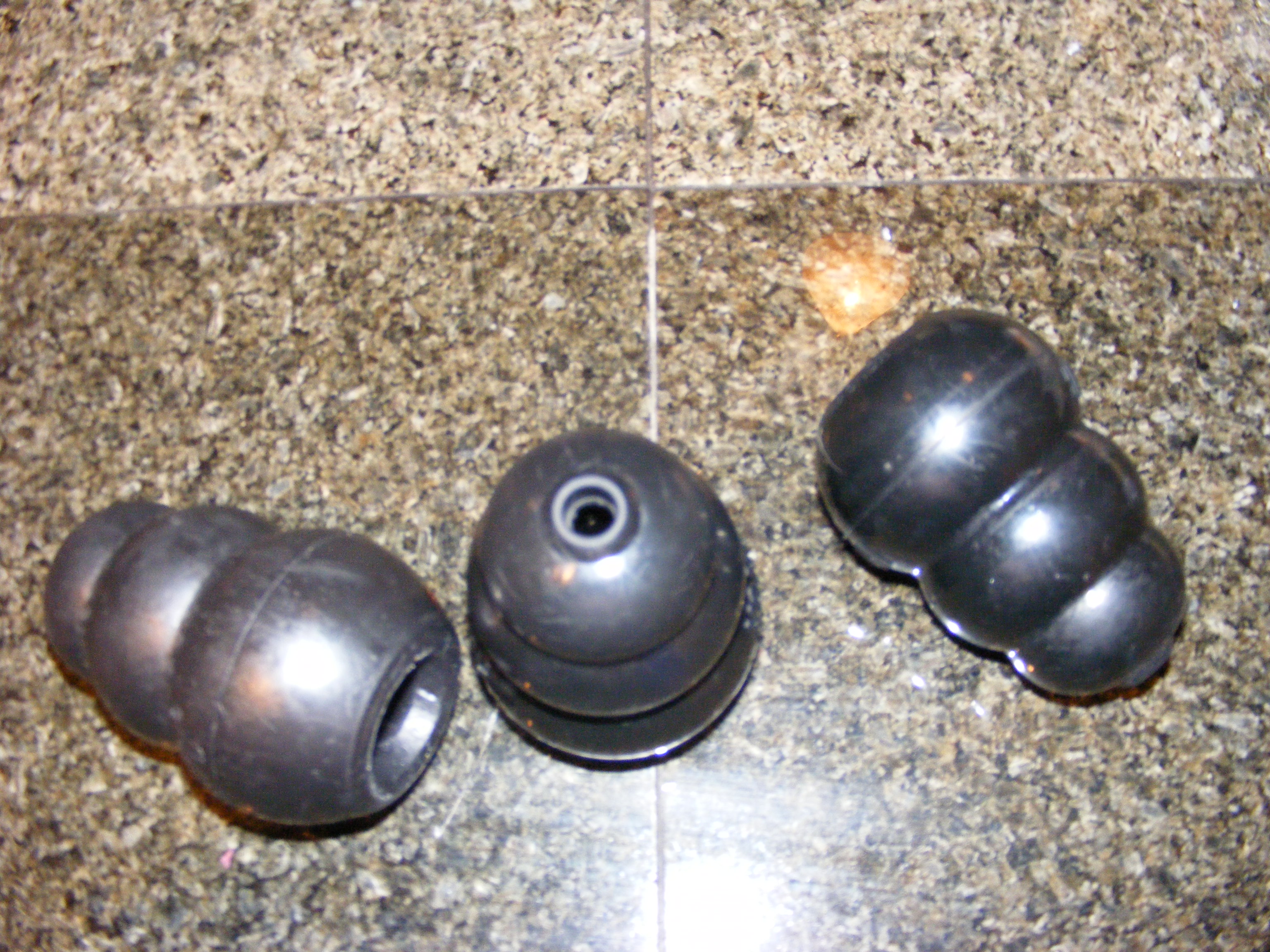
In a recent post I stated that I didn’t cook for the dog. This isn’t exactly “cooking.” Kongs are wonderful things. They have red ones for moderate chewers, and black ones for serious chewers. Zoe eats frozen solid raw food so is of the serious variety.

She now has five Kongs. With a knife, I insert about 1T peanut butter into the large hole in the bottom, and freeze solid. When we both leave the house, Zoe gets fresh water and a frozen Kong in her crate.

On weekends, she waits impatiently for us to leave to go to lunch and a movie. She runs into her crate eager to eat her peanut butter Kong or what we call a “doggie popsicle.”

She used to be left with full run of the place, but a couple of years ago, she had a friend over. I took them out for a walk, then left them for eight minutes while I walked the neighbor’s dog.

During my brief absence. they flipped the privacy deadbolt (no key on the outside) and locked me out. No cell phone…. I went down to the office to tell them I was locked out and they offered me a key. Then I said “no, you don’t understand” and awaited the inevitable laugh.

It took a maintence man three hours to get me back in, finally drilling a three-inch hole and inserting an extra deadbolt with a key on the outside. We’re the only unit with two-keyed entry.

That’s why Zoe is crated, but the PBK’s assure that crating is not doggie jail.

Hope you’re having a great weekend. Dee

Thinking

We should all be doing this regularly, the thinking thing, that is. Let’s think about what happens when we get up in the morning and have to make breakfast. Hello, if I’m talking to guys they’re probably single. If not, rant.

Must say that I love the husband I have but I’d never let him cook a meal because I know what a disaster he is in the kitchen. And our cookware, forget it. Dropped on a concrete floor and squared too many times.

The dog is allowed but for only about a minute per day when she has to chew and swallow raw frozen lamb or venison. With a lot of veggies. Plus dry food and organic chix broth. Then she hangs outside the kitchen and watches me, like a hawk.

How do you feel about your kitchen domain? I don’t even think about it now but at some point boundaries were set.

Let me leave you by saying love your family and friends and treat them well. I’m sure if you’re a cook they flock to you and depend on you so do your best to be there for them.

People will remember us in our hospitality, our interest in their well-being, camaraderie and thoughtful food.

Health and happiness.

Dee

The Pink Cooler

I just remembered a story from our glory days as young staffers in Albany. We booked the Speaker’s conference room for a staff party, about 65 of us, and Dennis, office mate, and I were organizing. Dennis had a recipe for this nasty pink punch and I was the only person on staff who had a real punch bowl.

The lone punch bowl and ladle (at 22 I had this stuff from family) were brought in but Dennis decided he was going to make the brew in a five gallon water bottle and serve it in the Speaker’s water cooler.

For weeks afterwards the very important ladies in the Speaker’s office said their water was pink and they didn’t know why (they probably also got a nice buzz going by afternoon). So I’m guessing the statute of limitations allows me to tell that story now.

We also had a big fight about who was going to cater the summer staff bbq. It cost us each $5, exhorbitant! OK so it was five bucks for a single gal and the same amount for a family of five. There goes the raise issue again.

Come event time massive rainstorms were forecasted so we scheduled a conference room and instead of a caterer for 100+ people each “team” would do their own thing. So I made vichysoisse and cucumber canapes as part of an elegant 6-course meal, and one team member brought in a silver candelabra and salt and pepper shakers and I think I added great-grandma’s embroidered linen tablecloth.

Everyone else had sandwiches or stuff they bought at the cafeteria. They thought we were nuts. Sometimes one needs to be outrageous.

Recently a couple of young friends described a barbeque with no tools, no plates…. To my chagrin I realized that my pantry includes a plumbing key for the grills and fireplace, gas torch, enough plastic plates and cups and utensils for fifty, matching napkins and grill tools that show that yes, I’m an adult now. Dee